For homeowners in Indiantown, Florida 34956, water filtration deserves more than a conversation about taste. Published records identify disinfection byproducts, a PFAS compound, and naturally occurring radioactivity as issues worth understanding. The right response is to match treatment to the substances of concern—and distinguish older summaries from newer findings.
Reviewed October 27, 2026. This article discusses historical utility records and health benchmarks. It does not establish the current condition of any individual tap or replace a current utility notice.
Legal does not necessarily mean safe
A legal limit and a health-based target answer different questions. EPA explains that enforceable maximum contaminant levels consider treatment feasibility and cost, while its non-enforceable health goals focus on protecting health. Compliance is meaningful, but it does not promise zero risk or the absence of contaminants.
EWG uses its own health benchmarks to evaluate utility measurements. Those benchmarks are not enforceable drinking-water limits, and exceeding one does not prove that a particular resident will become ill. They can, however, give a household a reason to consider reducing exposure beyond what regulations require.
What EWG reports for the Village of Indiantown
The EWG Tap Water Database entry for the Village of Indiantown lists eight detected contaminants, with four above its health guidelines. These are the summary values displayed when reviewed:
| Contaminant | EWG utility summary | EWG health guideline |
|---|---|---|
| Haloacetic acids (HAA5) | 38.0 ppb | 0.1 ppb |
| Perfluorohexane sulfonate (PFHxS) | 8.00 ppt | 0.001 ppt |
| Combined radium-226 and radium-228 | 2.15 pCi/L | 0.05 pCi/L |
| Total trihalomethanes (TTHMs) | 42.5 ppb | 0.15 ppb |
Units matter: ppb means parts per billion, ppt means parts per trillion, and pCi/L measures radioactivity. EWG’s page labels its main dataset 2018–2023; its PFHxS detail describes a broader 2013–2024 data window. These historical summaries are not today’s measurements. Its compliance statement refers specifically to April–June 2024, not current compliance.
Newer official findings: the 2024 report also lists violations
The Village’s 2024 Water Quality Report describes water from six Anastasia aquifer wells, treated through aeration, filtration, and chloramine disinfection. Its October 2024 disinfection-byproduct entries are marked “Y” for an MCL violation:
| 2024 report entry | Reported level detected | Listed legal limit |
|---|---|---|
| HAA5 | 159.8 ppb; individual results 142.8–159.8 | 60 ppb |
| TTHMs | 244 ppb; individual results 222.9–244 | 80 ppb |
The report says a public notice was issued for these exceedances. Therefore, describing Indiantown’s water simply as “legal but concerning” misses part of the record: the older EWG summaries and the newer violation entries tell different stories. The 2024 report is not a statement of today’s compliance. Ask the utility for its latest annual report, recent sampling, corrective actions, and any notice affecting your address.
Do not combine the EWG averages with the official report’s highest individual results as though they were the same statistic. Neither document measures the water leaving every household faucet.
Why these contaminants deserve attention
- HAA5 and TTHMs: These groups can form when disinfectants react with material in source water. EPA lists increased cancer risk among the potential effects of long-term exposure above their MCLs; TTHMs also have listed liver, kidney, and central-nervous-system effects. These are potential long-term risks, not a diagnosis for residents.
- PFHxS: This is one specific PFAS, not a measurement of all PFAS combined. EPA’s 2025 toxicological review concludes that PFHxS likely causes immune toxicity in humans under sufficient exposure conditions. An older utility detection does not determine a person’s dose or medical outcome.
- Radium: Radium-226 and radium-228 are radioactive substances that can originate in natural deposits. EPA associates long-term exposure above the combined radium MCL with increased cancer risk. A standard carbon filter should not be assumed to address dissolved radium.
Disinfection also has an essential purpose: controlling germs. CDC explains why utilities use chlorine or chloramine to protect water as it travels through pipes. The goal is to manage contaminants and treatment byproducts while preserving microbial protection.
Point-of-use filtration: focus on drinking and cooking
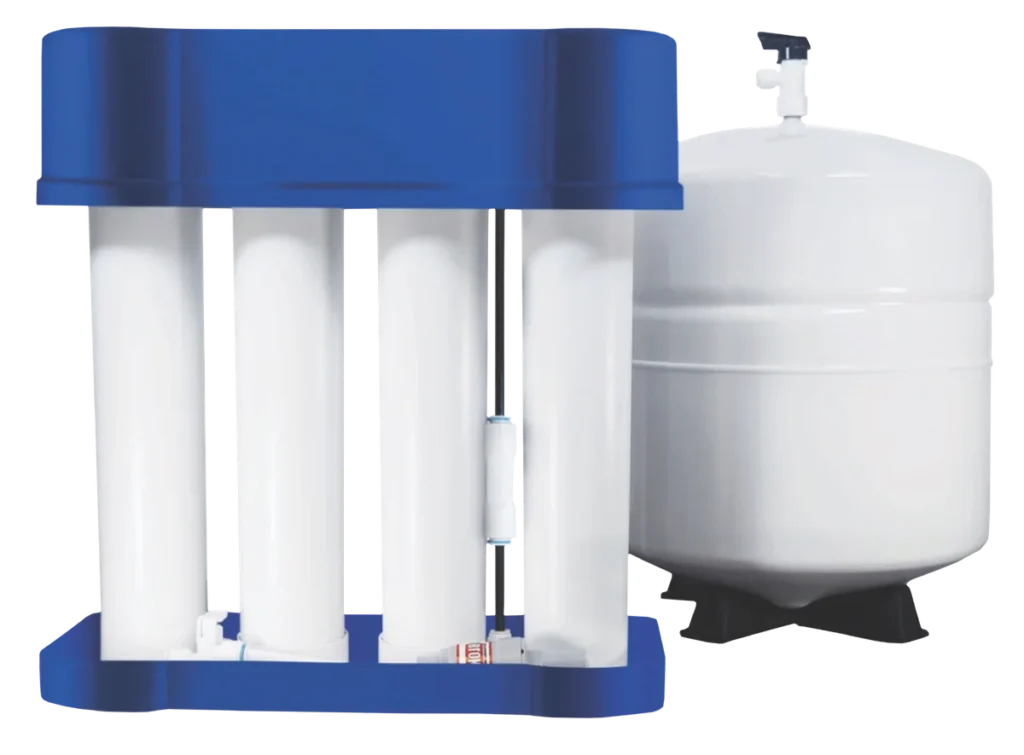
A point-of-use system treats water at a selected faucet, commonly the kitchen sink. This can be a practical first step when the priority is water for drinking, cooking, and making beverages. Compare a documented carbon-block system with reverse osmosis based on the actual treatment targets.
NSF emphasizes that certification does not cover every contaminant. NSF/ANSI 42 concerns specified aesthetic claims; NSF/ANSI 53 covers specified health-related reduction claims; NSF/ANSI 58 applies to reverse-osmosis systems. Read the exact model’s reduction list, capacity, and inlet-water requirements. A standard number alone is not a promise to reduce HAA5, TTHMs, PFHxS, and radium together.
For PFHxS, ask for documentation naming that compound. A claim for PFOA/PFOS should not automatically be extended to every PFAS. EPA’s PFAS filter guidance discusses carbon, ion exchange, and RO, and stresses maintenance and verified claims. For radium, review a system specifically documented for radium reduction; RO may be an option, but confirm the model rather than assuming.
Whole-house filtration: a different job, with different demands
Whole-house, or point-of-entry, treatment addresses water entering the home. It may make sense when a verified concern or a taste-and-odor goal affects multiple taps. For Indiantown’s chloraminated supply, require documentation for chloramine reduction at your household’s peak flow and the proposed media’s service life.
Sediment filtration, carbon treatment, softening, and RO perform different jobs. A sediment filter is not a treatment for dissolved PFAS or radium. A hardness softener is not a universal contaminant filter. If whole-house treatment is proposed for a health-related concern, request evidence for that exact substance, system, flow, and expected replacement interval.
CDC warns that removing disinfectants with some whole-home filters can allow more germs to grow in plumbing, especially when filters are neglected. Plan for maintenance and appropriate plumbing hygiene. A household may reasonably choose whole-house treatment for broader goals plus a separately selected kitchen system for drinking water; two systems are useful only when each has a defined purpose.
A practical plan for an Indiantown home
- Confirm your supplier. The Village’s report applies to its water system, not every property with an Indiantown mailing address. Private wells need their own testing.
- Get current information from the utility and choose appropriate laboratory testing for your concern. A pH, ORP, or TDS demonstration cannot identify these contaminants or establish drinking-water safety.
- Compare exact reduction claims, installation costs, flow, cartridge or media life, and ongoing service. Consider post-installation testing for a documented contaminant concern.
- Follow official boil-water or do-not-drink instructions even if you own a filter. CDC’s advisory guidance explains that filtered water still needs boiling during a boil-water advisory; boiling is not a universal fix for chemical contamination.
Kangen Water Stuart helps Treasure Coast households compare drinking-water filters and RO with whole-house options. Bring your utility report and specific concerns so we can review documented capabilities and limitations. Request an Indiantown filtration consultation or call (772) 872-6575.